Germany »
Germany is Europe’s largest economy and second most populous nation (after Russia). European power struggles immersed Germany in two devastating World Wars in the first half of the 20th century and left the country occupied by the victorious Allied powers of the US, UK, France, and the Soviet Union in 1945. With the advent of the Cold War, two German states were formed in 1949: the western Federal Republic of Germany (FRG) and the eastern German Democratic Republic (GDR). The democratic FRG embedded itself in key Western economic and security organizations, the EC, which became the EU, and NATO, while the communist GDR was on the front line of the Soviet-led Warsaw Pact. The decline of the USSR and the end of the Cold War allowed for German unification in 1990. Since then, Germany has expended considerable funds to bring Eastern productivity and wages up to Western standards. In January 1999, Germany and 10 other EU countries introduced a common European exchange currency, the euro.
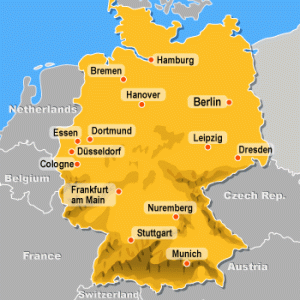
Click to enlarge
Capital: Berlin
Population: 81,147,265 (July 2013 est.)
Currency: Euro
Official Language: German
Ethnicity/race: German 91.5%, Turkish 2.4%, other 6.1% (made up largely of Greek, Italian, Polish, Russian, Serbo-Croatian, Spanish)
Religion: Protestant 34%, Roman Catholic 34%, Muslim 3.7%, unaffiliated or other 28.3%
* Source: CIA Factbook
3 Interesting Facts:
- Germany was the first country in the world to adopt Daylight saving time in 1916 during WWI.
- The Autobahn highway is the oldest motorway network in the world and the only one in Europe without a general speed limit (certain sections excepted).
- Germans have been pioneers of the ecological and green politics movements. Germans are very serious about recycling and Germany is one of the very few countries to have its Green Party as part of a government coalition.
~


 Cris2Travel
Leave a comment
Comments 0