Hungary »
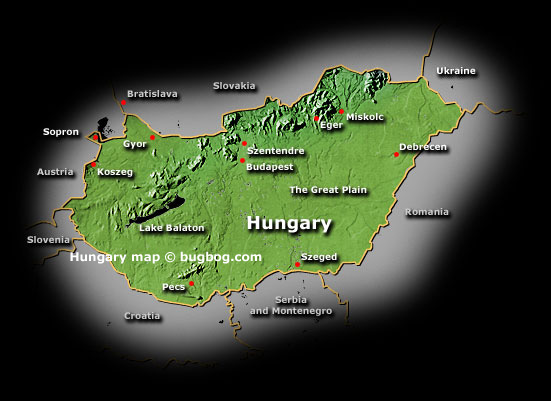
Click on image to enlarge
Hungary became a Christian kingdom in A.D. 1000 and for many centuries served as a bulwark against Ottoman Turkish expansion in Europe. The kingdom eventually became part of the Austro-Hungarian Empire, which collapsed during World War I. The country fell under communist rule following World War II. In 1956, a revolt and an announced withdrawal from the Warsaw Pact were met with a massive military intervention by Moscow. Under the leadership of Janos Kadar in 1968, Hungary began liberalizing its economy, introducing so-called “Goulash Communism.” Hungary held its first multiparty elections in 1990 and initiated a free market economy. It joined NATO in 1999 and the EU five years later (2004). In 2011, Hungary assumed the six-month rotating presidency of the EU for the first time.
Capital: Budapest
Population: 9,976,062 (July 2011 est.)
Currency: Hungarian Forint – HUF
Official language: Hungarian
Ethnicity/race: Hungarian 92.3%, Roma 1.9%, other or unknown 5.8% (2001 census)
Religion: Roman Catholic 51.9%, Calvinist 15.9%, Lutheran 3%, Greek Catholic 2.6%, other Christian 1%, other or unspecified 11.1%, unaffiliated 14.5% (2001 census)
* Source: CIA Factbook
3 Interesting Facts:
- The Rubik’s cube, ballpoint pen and holography were invented by Hungarians.
- The Hungarian language belongs to the Uralic family and has some relation to both Finnish and Turkish – even though these relations are quite distant.
- There are approximately 500 places in the country where thermal water occurs. That means you can find water with temperature above 30°C in the 70% of Hungary. There are about 150 spas in the country where you can bath.
Tips:
- Be careful about taking pictures of people in Hungary, especially if you are focused on street photography and locals are your main subject. You may be breaking the law! Click here to read more.


 Cris2Travel
Leave a comment
Comments 0