Latvia »
The name “Latvia” originates from the ancient Latgalians, one of four eastern Baltic tribes that formed the ethnic core of the Latvian people (ca. 8th-12th centuries A.D.). The region subsequently came under the control of Germans, Poles, Swedes, and finally, Russians. A Latvian republic emerged following World War I, but it was annexed by the USSR in 1940 – an action never recognized by the US and many other countries. Latvia reestablished its independence in 1991 following the breakup of the Soviet Union. Although the last Russian troops left in 1994, the status of the Russian minority (some 28% of the population) remains of concern to Moscow. Latvia acceded to both NATO and the EU in the spring of 2004; it joined the eurozone in 2014.
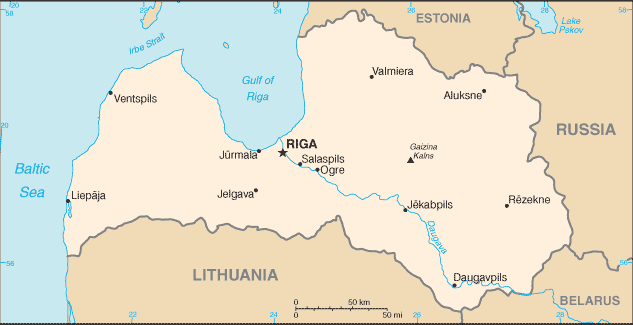
Click to enlarge
Capital: Riga
Population: 2,178,443 (July 2013 est.)
Currency: Euro (as of Jan. 2014 – previously, Lats)
Official language: Latvian
Ethnicity/ race: Latvian 59.3%, Russian 27.8%, Belarusian 3.6%, Ukrainian 2.5%, Polish 2.4%, Lithuanian 1.3%, other 3.1% (2009)
Religion: Lutheran 19.6%, Orthodox 15.3%, other Christian 1%, other 0.4%, unspecified 63.7% (2006)
*Source: CIA Factbook
3 Interesting Facts:
- Latvia is one of three countries known as the “Baltic States”. The other Baltic State countries are Estonia and Lithuania. Latvia is also known as Lettland.
- Russian is still used in commerce and daily life. English and German are also widely used.
- Ever wonder who inspired Crocodile Dundee? A Latvian named Arvīds Blūmentāls, who allegedly killed 10,000 crocodiles.


 Cris2Travel
Leave a comment
Comments 0